Monday, March 22, 2010

Antonio Canova for I weep with delight at his genius

That and his work is brilliance at its purest.


Here he is at work

Antonio Canova (1757-1822) was an Italian sculptor made famous for his masterful marble sculptures that his genius hands delicately rendered to resemble nude flesh. His pieces are the epitome of the neoclassical style. Canova’s work brilliantly marked a return to classical refinement of the Renaissance masters after decades of the theatrical excesses of Baroque sculpture.

A detail of his extraordinary talents

Canova was considered the greatest sculptor of his time and one has but to look at his work to see how very true that assessment was. His work and gentlemanly personality became a model for all sculptors for many years.
.

Canova's bust of Napoleon

In 1802, Canova was invited to Paris by Napoleon, in order to carve marble portraits of the emperor and his mother and sister.
.
Cupid and Psyche
.
'Psyche Revived by Cupid's Kiss' was commissioned in 1787 and acquired by Joachim Murat in 1800, and entered the Louvre in 1824. Canova was a prolific sculptor, and he seduced the whole of Europe with his mythological compositions in which the purity of contours was used to portray a discrete eroticism.
.
My personal favorite 'Nu'

Canova illustrates the Romantic Classicism that was so valued at the time: he creates daring images of seductive elegance and form. Both the supple figures and tactful features of his work recall the earlier Rococo, with its charm and realism, but he is firmly Neoclassic in his approach.
.
The three graces

In the area of portraiture he was the absolute champion of idealization. He displayed a sensibility both to naturalism and to the early Renaissance, opening the way to two dominant trends at the beginning of the century: skilled realism and historical subject matter.

A lovely way to start the week, I think.
My love, my care,
Simone

Saturday, March 20, 2010

It is so very bleak today

And there are a handful of invitation to which I must attend. Baby showers for a few of my former brides, two birthdays [one for a 40 year old anther for an infant], one house warming [done so my friend B.B can show off her new space] and the first wedding invitation of the season.

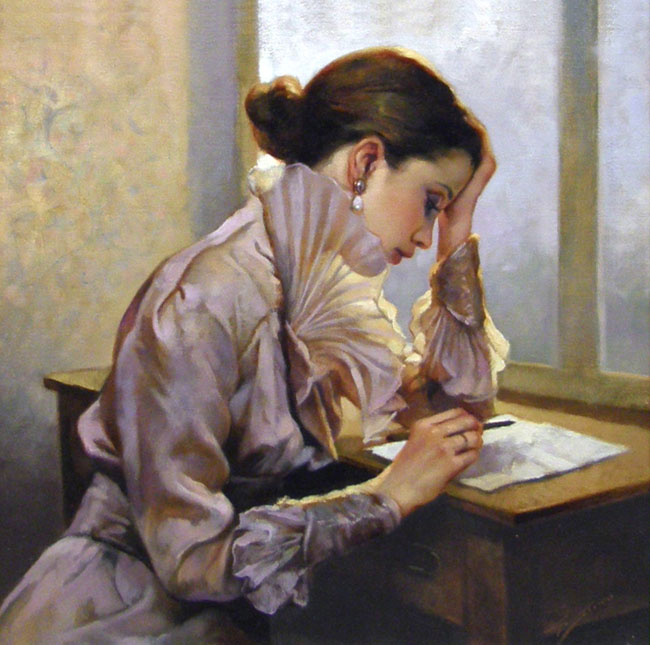
Yuqi Wang's Portrait of Fiona Wilmot-Sitwell


Oh, the little things we do for love

You gave him your body not a month after vowing it to me, for he said, “His body jumps when you are close.”
It seemed so simple a thing but it had pulled at your vanity and desire. I saw that even from across the room.
You pulled blood biting into his flesh in order to muffle your cries as he took your virtue in the coatroom at your Aunt Edith’s funeral but then you are no good at self-denial.
I’ll pretend not to notice for we are but a month married, that and I fucked your maid of honour the afternoon I picked her up from the airport for our wedding.

I long for summer today.
All my love,
Simone

Thursday, March 18, 2010

An Odd Sort of Expression

I love this painting even though I was never truly able to read her expression but then I think that was part Stewart's intent as a part of intimate space and us the happy voyeur.
.
Julius LeBlanc Stewart's In The Boudoir

Still I miss you
You were there one quarter of an hour before I notice and I thought it meant indifference.
I saw her at your side and felt nothing but peace that you were able to find happiness elsewhere.
You took my hand in greeting and I was capable of articulate speech so naturally I believe it an injury healed.
I was certain of my recovery until the instant I all but broke into tears when my husband asked at the end of the night, “If I had a good time.”

I've been a rotten blogger friend lately but I'll call as soon as time allows.
All my love and care,
Simone

Tuesday, March 16, 2010

Allow me to present Patricia Watwood a modern master

She is a truly talented painter and her work makes me rhapsodize.

Patricia Watwood Psyche's Doubt painted in 2004

So I may feel your want

Take my hand and let me know how much you want me.
Whisper in my ear a wicked request.
Run your hand up my skirt and lay claim to your want.
Bit my lips for kisses are no longer enough.
Take me in hand, as one does the neglected for it is the only way to show me how much.
Lick the sole of my feet and hold my eyes until I remember why I can never say no to you.
Put your hands on me.
Remind me with touch what it is like to be held by you.

Music and Poetry by Patricia Watwood

Seek her out for she is worth knowing.

All my love and care,

Simone

Sunday, March 14, 2010

William Hone Master Satirist and Defender of Freedom for the Press

William Hone (1780-1842) radical, satirist, and antiquarian. His victorious court battle against government censorship in 1817 marked a turning point in the fight for British press freedom.

He was born at Bath into a Congregationalist family, but moved at the age of ten to London, where he worked at first as a lawyer’s clerk. By the age of sixteen he had joined the London Corresponding Society, and had become a cynic in religion. In 1792, Hone takes his first adult position as "factotum" for solicitor in Bishopsgate Street.

Hone disliked the law and was employed by the booksellers as auctioneer to the trade, and had an office in Ivy Lane. Independent investigations carried on by him into the condition of lunatic asylums led to business difficulties and failure. In order to keep himself and his large family fed he contributed to magazines and reviews.

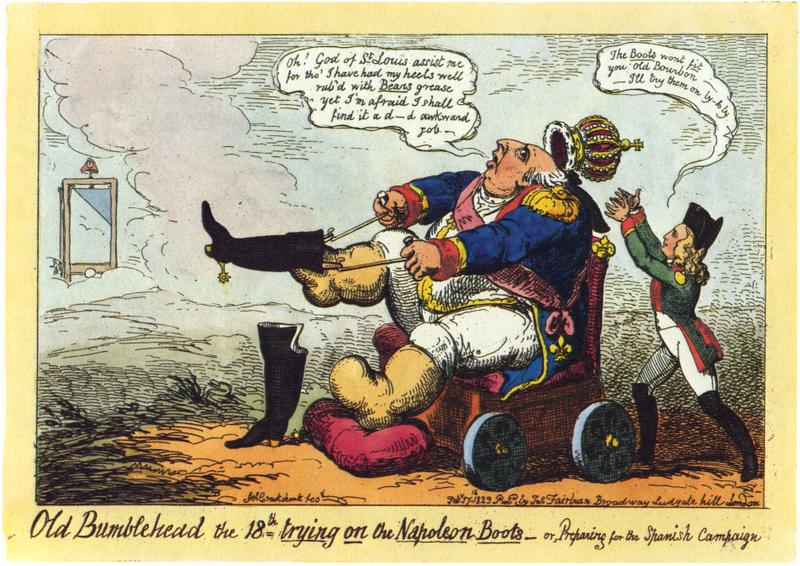
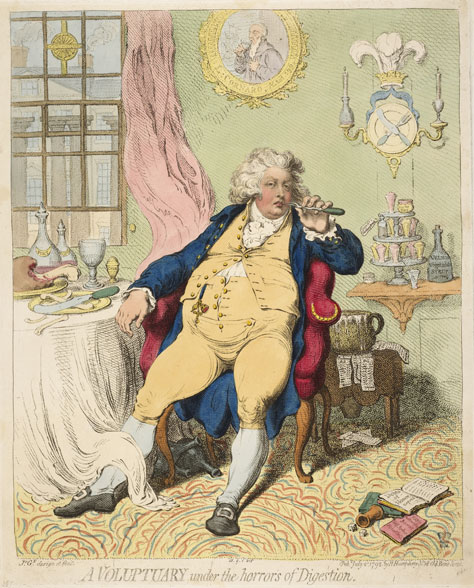
An unflattering caricature of George IV of the United Kingdom as Prince Regent, by George Cruickshank, illustrating "The Political House that Jack Built" by William Hone

In 1815 he started the Traveller newspaper, and tried in vain to save Eliza Fenning, a cook convicted on thin evidence of poisoning her employers with arsenic. Although Fenning was executed, Hone's 240 page book on the subject, The Important Results of an Elaborate Investigation into the Mysterious Case of Eliza Fenning was a landmark in investigative journalism it also demolished the prosecution's case.

This is typical of satire for which Hone would be tried

From 1 February to 25 October 1817, Hone published the Reformists' Register, using it to criticise state abuses, which he later attacked in the famous political squibs and parodies, illustrated by George Cruikshank. In April 1817 three ex-officio informations were filed against him by the attorney-general, Sir William Garrow.

THE CLERICAL MAGISTRATE by William Hone
Three separate trials took place in the Guildhall before special juries from th 18th to 20th of December 1817. The first, for publishing The Late John Wilkes's Catechism of a Ministerial Member (1817), was before Mr Justice Abbot (afterwards Lord Tenterden); the second, for parodying the litany and libelling the Prince Regent in The Political Litany (1817), and the third, for publishing the Sinecurist's Creed (1817), a parody on the Athanasian Creed, were before Lord Ellenborough.
.

Alphabet for Beginners by William Hone
The prosecution took the ground that the prints were harmful to public morals and brought the prayer-book and even religion itself into contempt. The real motives of the prosecution were political: Hone had ridiculed the habits and exposed the corruption of those in power. He went to the root of the matter when he wished the jury "to understand that, had he been a publisher of ministerial parodies, he would not then have been defending himself on the floor of that court." In spite of illness and exhaustion Hone spoke on each of the three days for about seven hours. Although his judges were biased against him, he was acquitted on each count, and the result was received enthusiastically by immense crowds inside and outside the court.
William Hone a truly brilliant fellow.
A lovely week to you all.
My love and care,
Simone

Saturday, March 13, 2010

Vera Wang One of the 100 Women Who Inspires Me

Because she came to her destiny despite disappoint and is still at 60 a remarkable talent.


Vera Ellen Wang Becker was born and raised in New York has in a few decades has become synonymous with the ideal wedding gown.


She attended The Chapin School until her graduation in 1967 and went on to complete her education at the University of Paris and Sarah Lawrence College, obtaining a degree in art history.


While in high school, Wang trained as a figure skater with pairs partner James Stuart, and competed at the 1968 U.S. Figure Skating Championships. When she failed to make the US Olympics team, she entered the fashion industry.


Wang was a senior fashion editor for Vogue for sixteen years. In 1985, she left Vogue after being turned down for the editor-in-chief position currently filled by Anna Wintour and joined Ralph Lauren as a design director for two years. In 1990, she opened her own design salon in the Carlyle Hotel in New York that features her trademark bridal gowns.

I adore Vera's elegant take on the wedding gown and her urbane approach to fashion.
Warm regards and a lovely weekend to all,
My love my care,
Simone

Thursday, March 11, 2010

Someone who is quick to laugh

I had a late supper with a few of my girl friends late last night. Talk eventually turned to relationships and now I'm left to wonder...


Patrick Devonas' Ein Wanderers Nachtlied


Can a comfortable silence pass for love?

For I’ve seen it you know, a couple at dinner for two hours and not bothering to make conversation above the polite. No laughter. No flirting. Not even a bitter stare or sad longing.

Just civility.

I don't remember how it came to be a point of conversation but we all thought it a strange sort of thing to love one who detests tendre sentiment and even stranger still to do so for you fit well into the hollows of their body when you lay as spoons on the sofa to watch foreign films they interprets in an entirely different light than you.

Then we had cake and old boyfriends were dragged over hot coal. The one from my pass that was roasted had been a lover who felt everything keenly, as sun magnified through glass. He was forever burning with some emotion. When we parted he in some grand passion had stated fervently his distaste for what he called my ‘tidy rationale and tasteful decadence.’ I didn’t think his words fit me and told him so in something I’m guessing was calm logic for he flew off the handle as if I'd done so to deliberately provoke.

These days I tend to go for men who are quick to laugh.

We had too much red wine and were all done in today... so a good time was had by all.

Love and care,
Simone