Sunday, April 4, 2010

Art as always been for me an expression of the human condition

From the profound to the absurd. Here Landseer shows us heart and wit with no more than subject and talent.
.
Attachment by Sir Edwin Landseer

John Gay's poem: Monkey Who Had Seen The World says well the very same idea only the painting for me says it better. Tell me if you agree.

The Monkey Who Had Seen The World by Landseer

John Gay's poem: Monkey Who Had Seen The World

A monkey, to reform the times,Resolved to visit foreign climes;For therefore toilsomely we roamTo bring politer manners home.Misfortunes serve to make us wise:Poor pug was caught, and made a prize;Sold was he, and by happy doomBought to cheer up a lady's gloom.Proud as a lover of his chainsHis way he wins, his post maintains--He twirled her knots and cracked her fan,Like any other gentleman.When jests grew dull he showed his wit,And many a lounger hit with it.When he had fully stored his mind--As Orpheus once for human kind,--So he away would homewards steal,To civilize the monkey weal.

The hirsute sylvans round him pressed,Astonished to behold him dressed.They praise his sleeve and coat, and hailHis dapper periwig and tail;His powdered back, like snow, admired,And all his shoulder-knot desired.

"Now mark and learn: from foreign skiesI come, to make a people wise.Weigh your own worth, assert your place,--The next in rank to human race.In cities long I passed my days,Conversed with man and learnt his ways;Their dress and courtly manners see--Reform your state and be like me.

"Ye who to thrive in flattery deal,Must learn your passions to conceal;And likewise to regard your friendsAs creatures sent to serve your ends.Be prompt to lie: there is no witIn telling truth, to lose by it.And knock down worth, bespatter merit:Don't stint--all will your scandal credit.Be bumptious, bully, swear, and fight--And all will own the man polite."

He grinned and bowed. With muttering jawsHis pugnosed brothers grinned applause,And, fond to copy human ways,Practise new mischiefs all their days.

He grinned and bowed. With muttering jawsHis pugnosed brothers grinned applause,And, fond to copy human ways,Practise new mischiefs all their days.

My love, my care,
Simone

Friday, April 2, 2010

Because sometimes we are our own worst enemy

And on occasion even I forget that in order to pursuit ones passion, be it art or romance one is required to have guts.


I pray you forgive the executioner and allow her sleep

Pray her axe sharp and your pain brief
Pray you are allowed dignity in your final hour
But more than that insist of your god the life of your enemy
Pray you are not survived long by those who would see you without your head
Demand their end is that of a coward
But pardon the woman with the axe and pray her blade sharp and her hands sure
Especially if you are the author of your own end


The Execution of Lady Jane Grey by Paul Delaroche
Somedays constant fortification is needed to be a writer.
A lovely holidays to all,
Warm regards,
Simone

Wednesday, March 31, 2010

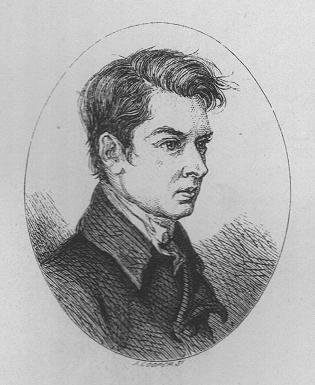
William Hazlitt simply the best


'The love of liberty is the love of others; the love of power is the love of ourselves,' written by Hazlitt.


'Happy are they who live in the dream of their own existence, and see all things in the light of their own minds; who walk by faith and hope; to whom the guiding star of their youth still shines from afar, and into whom the spirit of the world has not entered! They have not been "hurt by the archers", nor has the iron entered their souls. The world has no hand on them,' by Hazlitt.

William Hazlitt, the son of an Irish Unitarian clergyman, was born in Maidstone, Kent, on 10th April, 1778. His father was a friend of Joseph Priestley and Richard Price. As a result of supporting the American Revolution, Rev. Hazlitt and his family were forced to leave Kent and live in Ireland.


'Prosperity is a great teacher; adversity is a greater,' Hazlitt.

The family returned to England in 1787 and settled at Wem in Shropshire. At the age of fifteen William was sent to be trained for the ministry at New Unitarian College at Hackney in London. The college had been founded by Joseph Priestley and had a reputation for producing freethinkers. In 1797 Hazlitt lost his desire to become a Unitarian minister and left the college.

While in London Hazlitt became friends with a group of writers with radical political ideas. The group included Percy Bysshe Shelley, Samuel Taylor Coleridge, Charles Lamb, William Wordsworth, Thomas Barnes, Henry Brougham, Leigh Hunt, Robert Southey and Lord Byron. At first Hazlitt attempted to become a portrait painter but after a lack of success he turned to writing.


'The only vice which cannot be forgiven is hypocrisy. The repentance of a hypocrite is itself hypocrisy,' Hazlitt.

Charles Lamb introduced Hazlitt to William Godwin and other important literary figures in London. In 1805 Joseph Johnson published Hazlitt's first book, An Essay on the Principles of Human Action. The following year Hazlitt published Free Thoughts on Public Affairs, an attack on William Pitt and his government's foreign policy. Hazlitt opposed England's war with France and its consequent heavy taxation. This was followed by a series of articles and pamphlets on political corruption and the need to reform the voting system.

Hazlitt began writing for The Times and in 1808 married the editor's sister, Sarah Stoddart. His friend, Thomas Barnes, was the newspaper's parliamentary reporter. Later, Barnes was to become the editor of the newspaper. In 1810 he published the New and Improved Grammar of the English Language.


'Wit is the salt of conversation, not the food,' Hazlitt.

In 1813 Hazlitt was employed as the parliamentary reporter for the Morning Chronicle, the country's leading Whig newspaper. However, in his articles, Hazlitt criticized all political parties. Hazlitt also contributed to The Examiner, a radical journal edited by Leigh Hunt. Later, Hazlitt wrote for the Edinburgh Review, the Yellow Dwarf and the London Magazine. In these journals Hazlitt produced a series of essays on art, drama, literature and politics. During this period he established himself as England's leading expert on the writings of William Shakespeare.

Hazlitt wrote several books on literature including Characters of Shakespeare, A View of the English Stage, English Poets and English Comic Writers. In these books he urged the artist to be aware of his social and political responsibilities.

Hazlitt continued to write on about politics and his most important books on this subject is Political Essays with Sketches of Public Characters. In the book Hazlitt explains how the admiration of power turns many writers into "intellectual pimps and hirelings of the press."

Hazlitt's marriage to Sarah ended in 1823 as a result of an affair with a maid, Sarah Walker. Hazlitt wrote an account of this relationship in his book Liber Amoris. In 1824 Hazlitt married Isabella Bridgewater but this relationship only lasted a year.

In the The Spirit of the Age: Contemporary Portraits. Hazlitt provides a series of contemporary portraits including Samuel Taylor Coleridge, William Wordsworth, Robert Southey, William Cobbett, William Godwin and William Wilberforce. This was followed by The Plain Speaker and Life of Napoleon. William Hazlitt died in poverty of stomach cancer on 18th September 1830.

He is worth knowing so seek him out and read his text or an essay.

Warm regards,
Simone

Tuesday, March 30, 2010

Today marks 186 years since the death of this scandalous lady

Elizabeth Christiana Hervey Foster Cavendish, Duchess of Devonshire, 13 May 1759 - 30 March 1824, is best known as an early woman novelist, and as the close friend of Georgiana Cavendish, Duchess of Devonshire. Elizabeth supplanted the Duchess, gaining the Duke's affections and later marrying him.
.
Sir Joshua Reynolds. Lady Elizabeth Foster

Lady Elizabeth was the daughter of Frederick Hervey, 4th Earl of Bristol. In 1776, she married Irishman John Thomas Foster. The Fosters had three children; two sons, Frederick and Augustus John Foster and a daughter Elizabeth, who was born premature on 17 November 1778 and lived only 8 days.

The couple lived with her parents at Ickworth House, the ancestral Bristol home. The marriage was not a success, and the couple separated within five years, plausibly after Foster had a relationship with a servant. He retained custody of their sons, and did not allow the boys to see Bess for 14 years. In May 1782, Bess met the Duke and Duchess of Devonshire in Bath, and quickly became Georgiana's closest friend.

From this time, she lived in a ménage à trois with Georgiana and her husband, William, the 5th Duke of Devonshire, for about twenty-five years. She bore two children by the Duke: a son, Augustus later Augustus Clifford, 1st Baronet, and a daughter, Caroline St. Jules, who were raised at Devonshire House with the Duke's legitimate children by Georgiana. Lady Elizabeth finally married the Duke in 1809, three years after the death of his first wife, during which time she had continued to live in his household.

Angelica Kauffman painting of Lady Elizabeth Foster

All that and she wrote. She was the author of seven novels over the course of her lifetime: Melissa and Marcia, or the Sisters. A Novel; Louisa; The History of Ned Evans; The Church of St. Siffrid; The Mourtray Family. A Novel; Julia (which was never published); and Amabel; or, Memoirs of a Woman of Fashion. This last novel was the only one published with her name attached during her lifetime, and it was not on the cover, but on the dedication page. The rest of her novels were published anonymously.

Oh and there are letter too, Lady Elizabeth was a friend of the French author Madame de Staël, with whom she corresponded from about 1804.

And a wink, Lady Elizabeth Foster is the great-great-great-Grandmother of Vogue magazine's Anna Wintour.

I think her a captivating personality and I read her history with open fascination.

Warm regards to all,
My love and care,
Simone

Sunday, March 28, 2010

The Fantastic Mr. Parkes


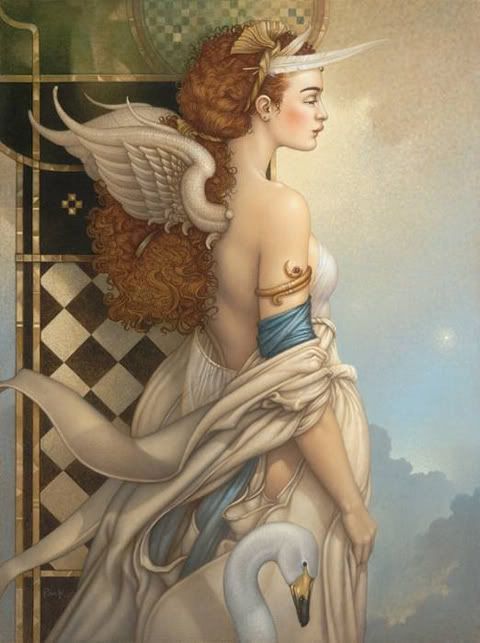
Fun, spiritual, thoughtful and brilliant, Michael Parkes for sometimes all that is required is idly whimsy and erotic fancy.

Angel Affair

He is to me both heretic and staunch believer. His art transcends the sometimes awful snobbery associated with fine art. If you are not familiar with is work here are a morsel to brighten your day.


The man is a devout to his craft and I encourage you to seek him out.

water music


Wishing you a brilliant Sunday.
Warmest regards,
Simone

Friday, March 26, 2010

The Eroticism of Decency

Or a love void of ego but not dripping in self-sacrifice

Andrea del Sarto's Saint John the Baptist

Yet another one of my writing ideas that went nowhere.

It was meant to be about how much one experiences light and laughter when in company with another. A sort of excellent love without the parasitic hold but then it did not make for a very good romance novel. For as it turns out a romantic story needs the high drama of longing, the anxious tension that pulls at heart and a measure of madness that drives desire.

Here is why I feel it did not work, decency is one dimensional and for a novel to be compelling or simply readable there needs to be layers of complex human traits and experiences.

So in this my private ambitions is superseeded by my lack of foresight and the romantic ideal set in place by those long published.

It is spring and the weekend so I'm grateful.
My very best to each of you,
Simone

Wednesday, March 24, 2010

Everything I know About Art I learned In High School

For this reason I support art in schools


This too was written in my high shool by Jennifer Blazina. It is to me a most brilliant piece and I never forgot it. I often wonder if she still writes.
ONLY ONCE
I saw your face just once.
Only once did I feel the warmth of your smile.
Then it disappeared in sorrow.
I heard your voice just once.
Only once did I hear you call my name
But the echoes soon ceased.
I felt the rain, but just for a moment
Before it mixed with my salty tears.
And I watched you walk away,
Turning your head back, but only once.
A brilliant day to each of you.
All my love and care,
Simone